Common blackbird
A widespread thrush known for its melodious song and black plumage.

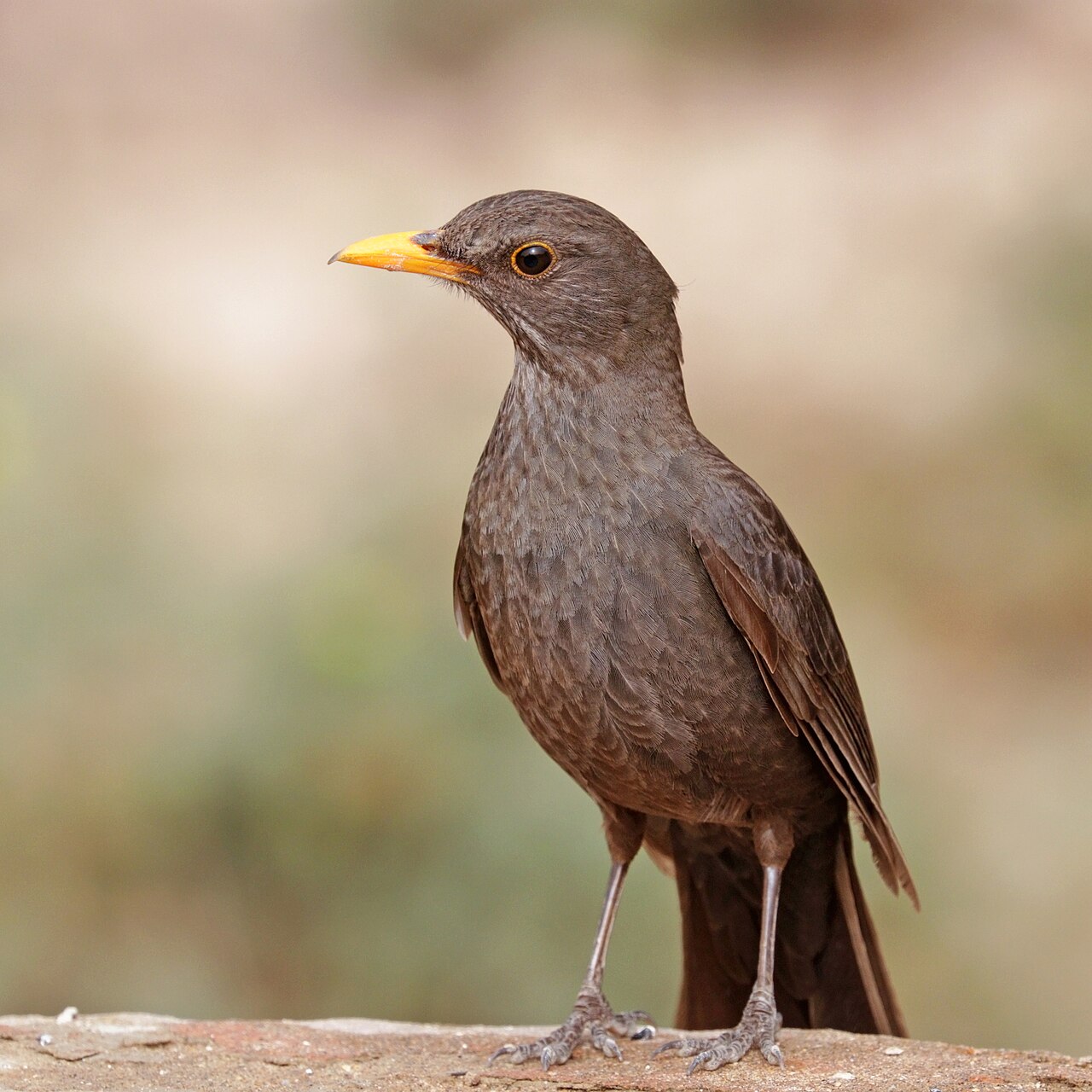
Charles J. Sharp · CC BY-SA 4.0
The common blackbird (Turdus merula) is a species of true thrush, also known as the Eurasian blackbird. It breeds in Europe, western Asia, and North Africa, and has been introduced to Australia and New Zealand. This common and conspicuous species has given rise to a number of literary and cultural references, often related to its song.
- Scientific name
- Turdus merula
- Family
- Turdidae (true thrushes)
- Length
- 23.5–29 cm
- Range
- Europe, western Asia, North Africa; introduced to Australia and New Zealand
- Subspecies
- Multiple, including nominate T. m. merula
- Conservation status
- Not specified in source
Lore & Background
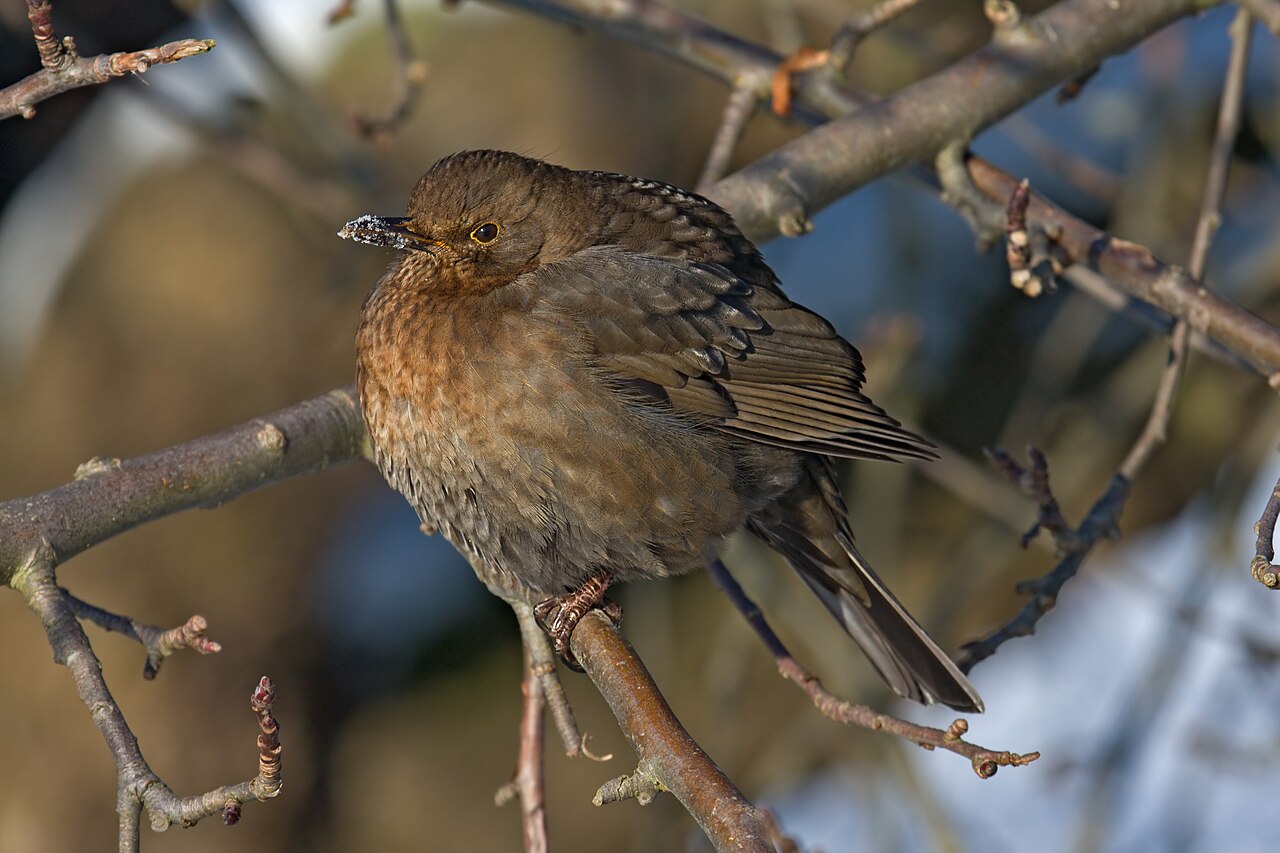
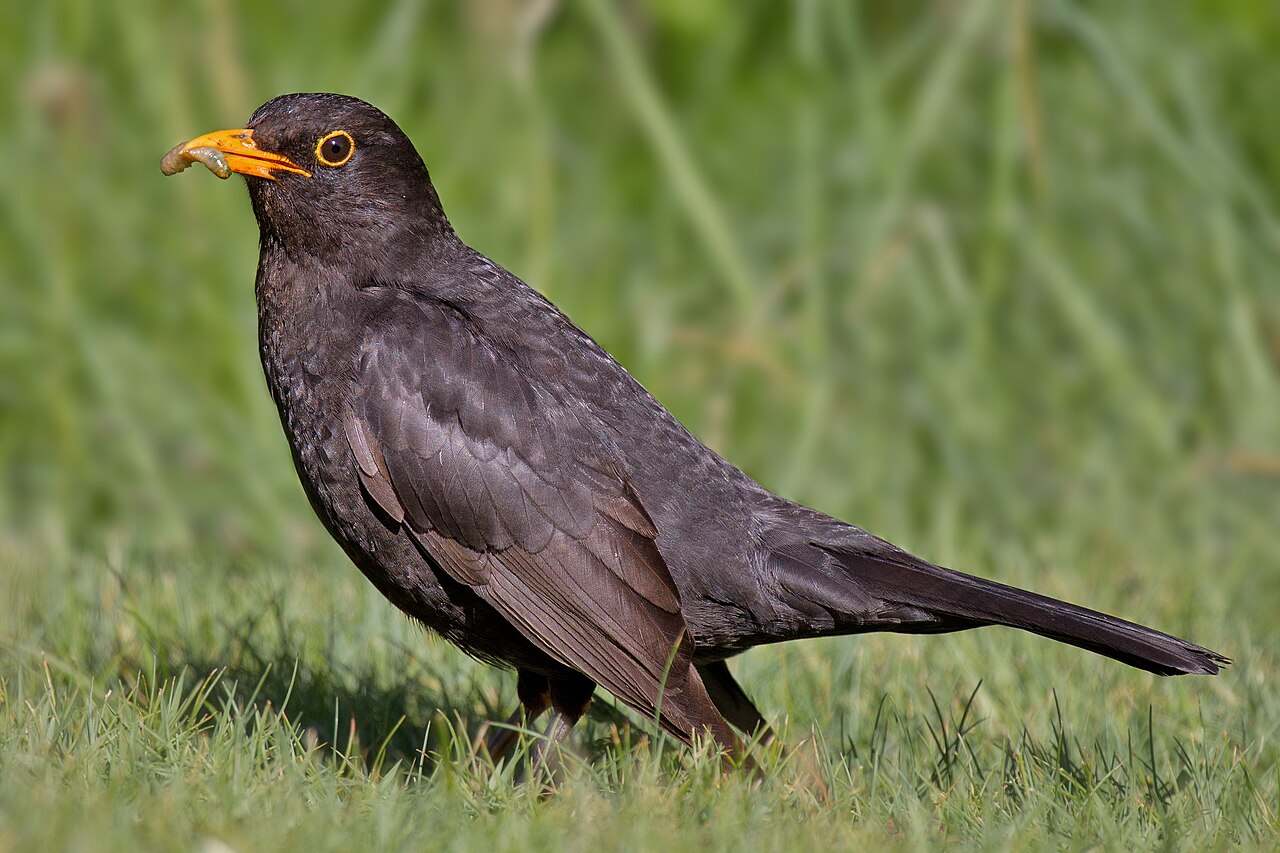
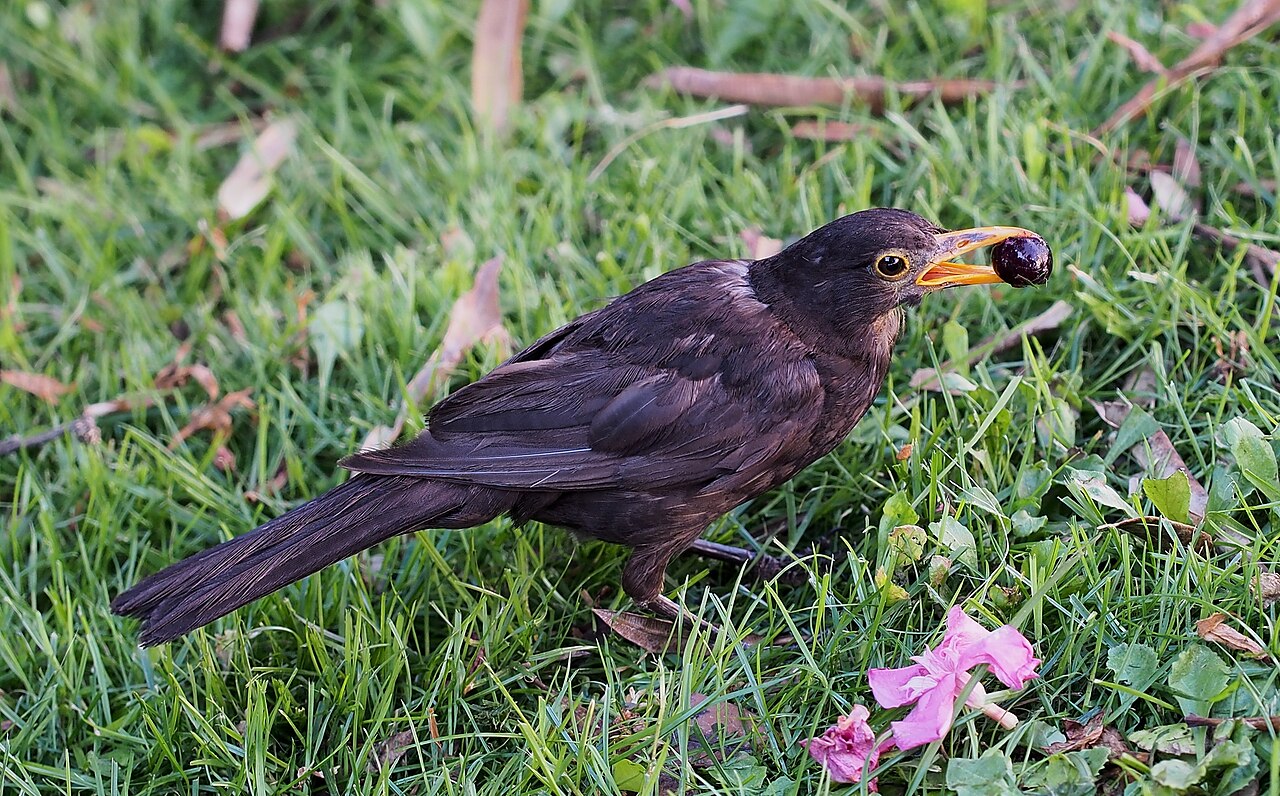
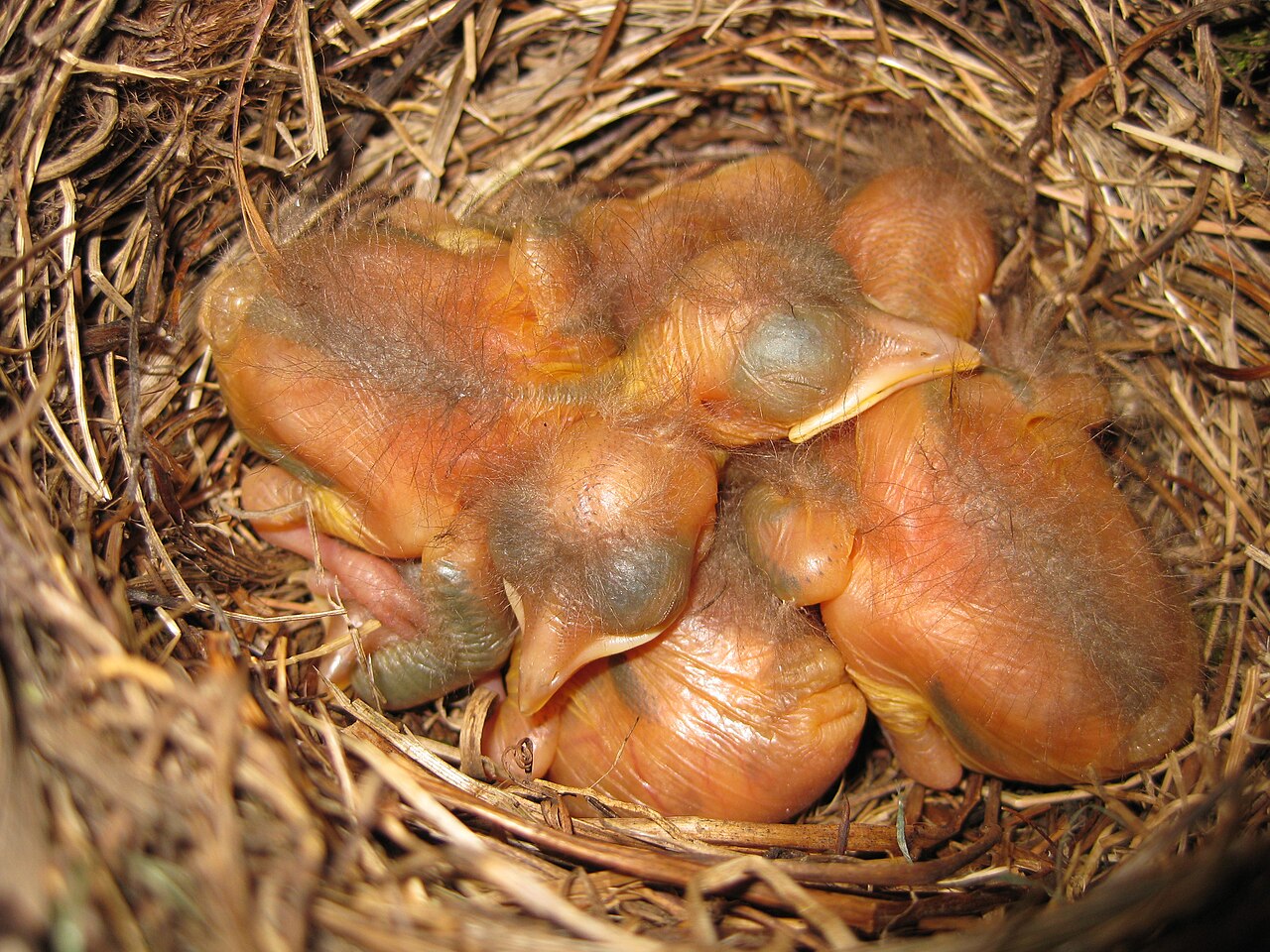
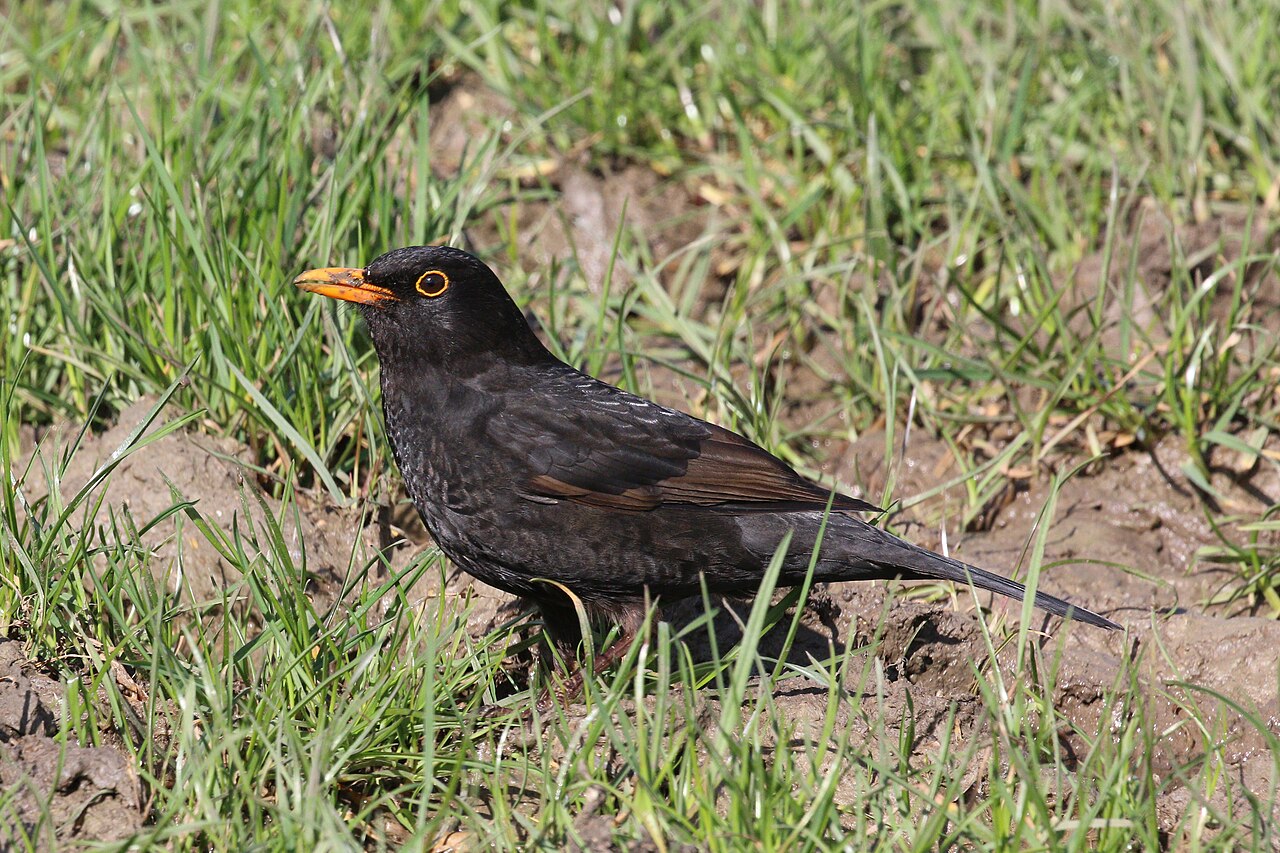
The binomial name derives from Latin turdus, 'thrush', and merula, 'blackbird'. The adult male of the nominate subspecies is all black except for a yellow eye-ring and bill, while the female and juvenile have mainly dark brown plumage. This species breeds in woods and gardens, constructing neat, cup-shaped nests bound together with mud. It is omnivorous, eating insects, earthworms, berries, and fruits. Both sexes are territorial on the breeding grounds, but more gregarious during migration and in winter. Depending on latitude, the common blackbird may be resident, partially migratory, or fully migratory.
Reader's Guide
The common blackbird is a significant species in ornithology and culture. It is one of the most familiar birds across its extensive range, breeding in temperate Eurasia, North Africa, the Canary Islands, and South Asia, with introduced populations in Australia and New Zealand. Its song has inspired numerous literary and cultural references. The species has several subspecies, with some former Asian subspecies now widely treated as separate species, such as the Indian, Tibetan, and Chinese blackbirds. The name 'blackbird' was applied to this species because in Old English, 'bird' referred only to smaller birds, while larger ones were called 'fowl'; thus the blackbird was the only widespread and conspicuous 'black bird' in the British Isles. The common blackbird is also notable for its evolutionary history: it is descended from ancestors that colonized the Canary Islands from Africa and subsequently reached Europe. It is close in evolutionary terms to the island thrush of Southeast Asia and the southwest Pacific.
Did You Know?
- The adult male has glossy black plumage, a yellow eye-ring, and an orange-yellow bill that darkens somewhat in winter.
- The species breeds in woods and gardens, constructing cup-shaped nests bound together with mud.
Evolutionary Roots & Global Spread
The Common blackbird belongs to the Passeri suborder, a lineage of perching birds that represents one of two major branches of living oscines, encompassing roughly four thousand species. Recent estimates place the origin of this group at approximately fifty million years ago. The geographic distribution of the earliest lineages points to an exclusively Australian cradle for the initial evolution and diversification of songbirds. It was only around forty million years ago that members of this clade began spreading outward, colonizing Eurasia, Africa, and eventually the Americas. The sister lineage, the Tyranni, numbers about a thousand species and is most diverse in the Neotropics, though it is absent from many regions of the globe. A third, far smaller lineage of perching birds, the Acanthisitti, is restricted to New Zealand, where just two species survive today. This deep evolutionary history and broad biogeographic sweep underscore just how ancient and widespread the vocal traditions that define the blackbird's world truly are.
The Instrument of Song
At the heart of the Common blackbird's vocal capabilities lies the syrinx, often called the song box, a highly specialized organ that sets oscines apart from most other birds. This structure sits precisely at the junction where the trachea splits into the two bronchial tubes that channel air into the lungs. It is a solid, bony framework internally lined with delicate membranes; when air is forced through these membranes, sound is produced. What is perhaps surprising is that the size or complexity of the syrinx does not reliably predict how well a bird can sing. Researchers instead point to the length of the windpipe as a more meaningful factor in vocal output. By comparison, the Tyranni possess a simpler syrinx musculature, and although their vocalizations can be equally complex and striking, they tend to sound more mechanical. The blackbird, as a member of the Passeri, benefits from the more elaborate vocal architecture that makes the rich, varied songs of oscines possible.
Courtship, Rivalry & the Repertoire Game
For the Common blackbird, song serves a dual purpose: it broadcasts an individual's identity and location to rivals while simultaneously signaling sexual readiness to potential mates. Sexual selection in this group leans heavily on mimetic vocalization, and in several studied populations, females show a clear preference for males who command a larger song repertoire. During courtship, males have been observed expanding their vocal output by imitating songs from other species, and the accuracy, retention, and sheer quantity of these borrowed phrases correlate positively with mating success. Males also use song to assert dominance and avoid physical confrontations, while females, though less frequently, may join in a duet to affirm a pair bond. An alternative song-sharing hypothesis proposes that some females actually favor simpler, more uniform songs that indicate a male rooted in familiar territory.
Beyond the Melody – Calls, Mimicry & Vocal Range
It would be a mistake to assume that every songbird produces what humans perceive as beautiful music. Within the Passeri, members of the crow family communicate largely through harsh croaks and screeches, though even these birds produce a softer, gentler twitter exchanged between courting partners. The Common blackbird, as an oscine, sits within a group where vocal mimicry is almost entirely the norm: while a few non-passerine birds, such as certain parrots, can be trained to parrot human speech, the natural capacity to imitate the calls of other species or ambient environmental sounds is essentially exclusive to songbirds, with lyrebirds and mockingbirds standing out as particularly accomplished copyists. It is also important to distinguish between song and call. Calls, used for alarm signals and maintaining contact within flocks during feeding or migration, are produced by nearly all living birds. Well-developed, melodious songs, by contrast, are restricted to a handful of lineages, and the oscines represent the most diverse and accomplished of those groups.
Gallery
Frequently Asked Questions
Who is Common blackbird?
Common blackbird (Turdus merula), also called the Eurasian blackbird, is a widespread true thrush celebrated for its glossy black plumage and rich, melodious song. It is one of the most recognizable and frequently encountered songbirds across the Old World.
What are Common blackbird's key physical traits?
Adults measure roughly 23.5 to 29 cm in length and display a predominantly dark, glossy body that makes them highly conspicuous in any habitat. Their striking black coloration, paired with a powerful and varied song, distinguishes them from many other thrushes.
Where does Common blackbird live in the wild?
The species breeds naturally across Europe, western Asia, and North Africa, and has also been successfully introduced to Australia and New Zealand. Its broad geographic spread makes it one of the most widely distributed songbirds in the family Turdidae.
Why is Common blackbird so culturally significant?
The bird's rich, varied singing has inspired countless literary and folkloric references throughout history. Its conspicuous appearance and musical abilities have made it a recurring symbol in poetry, natural writing, and popular culture.
What is Common blackbird's scientific classification?
Turdus merula belongs to the family Turdidae (true thrushes) and encompasses multiple recognized subspecies, including the nominate T. m. merula. It is a member of the thrush lineage rather than a parrot or other songbird group.
More in Parrots And Songbirds 1-17
Spotted an error? Know more?
This is a living reference — every entry is fact-audited, and reader corrections feed straight into our audit queue. Suggest an edit · See this site's audit record