Common hill myna
A talking starling of South and Southeast Asian hills.

AbirMahmud · CC BY-SA 4.0
The common hill myna (Gracula religiosa), sometimes spelled 'mynah' and formerly simply known as the hill myna or myna bird, is a species of starling found in the hills of South and Southeast Asia. It is a popular talking bird, and its specific name religiosa may allude to the practice of teaching mynas to repeat sacred prayers. The common hill myna is one of the most commonly spotted birds in Asian aviculture.
- Scientific name
- Gracula religiosa
- Type location
- Indonesian island of Java
- Average length
- About 29 cm
- IUCN status
- Least Concern
- Number of subspecies
- Nine recognised
Lore & Background
The genus name is from Latin graculus, an unknown bird sometimes identified as the western jackdaw. The specific epithet religiosa is from Latin religiosus meaning 'sacred'. Nine subspecies are recognised, including G. r. intermedia from northern India to Indochina, G. r. religiosa from the Malay Peninsula to Borneo, and G. r. miotera from Simeulue, which a 2020 study proposed as a distinct species; its status is critically endangered or possibly extinct, but it has not been definitively documented as extinct in the wild in the late 2010s.
Reader's Guide
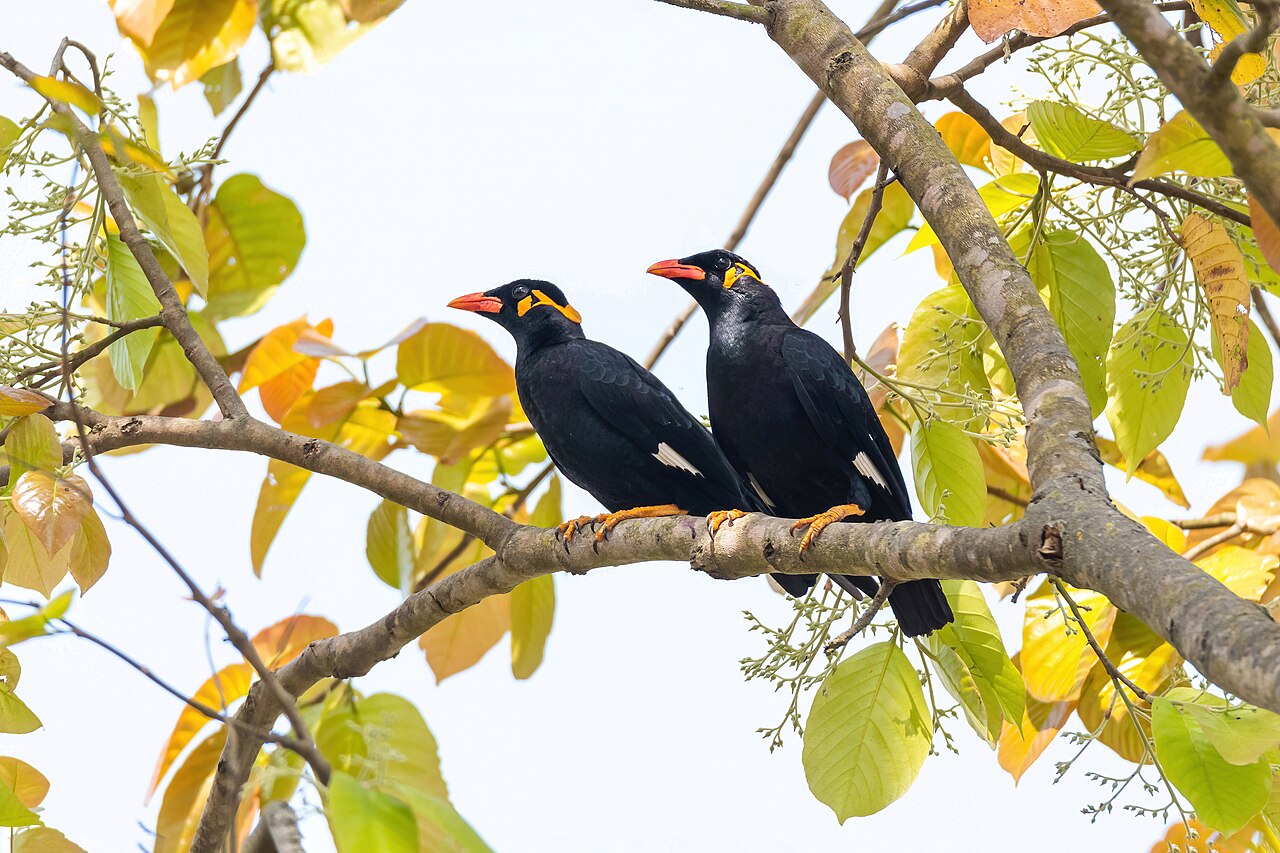
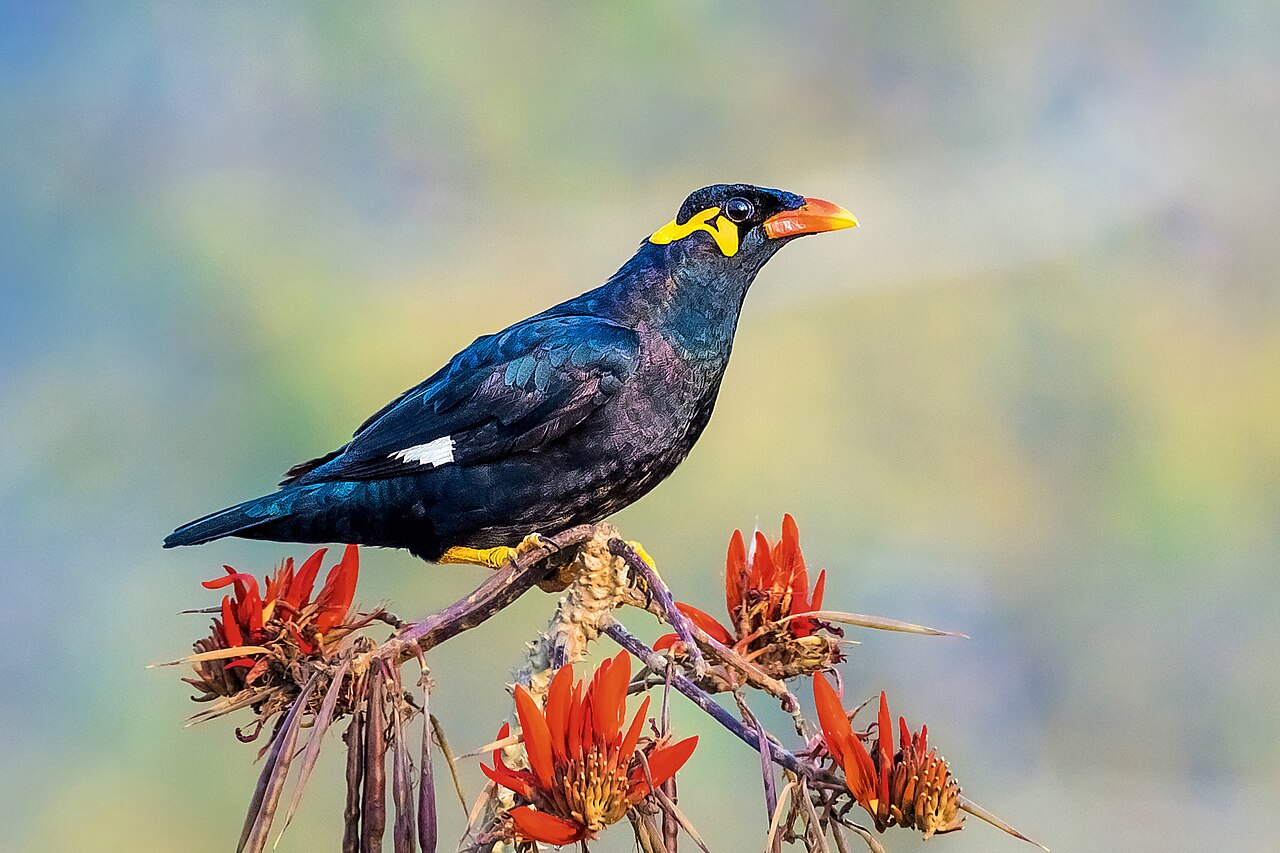
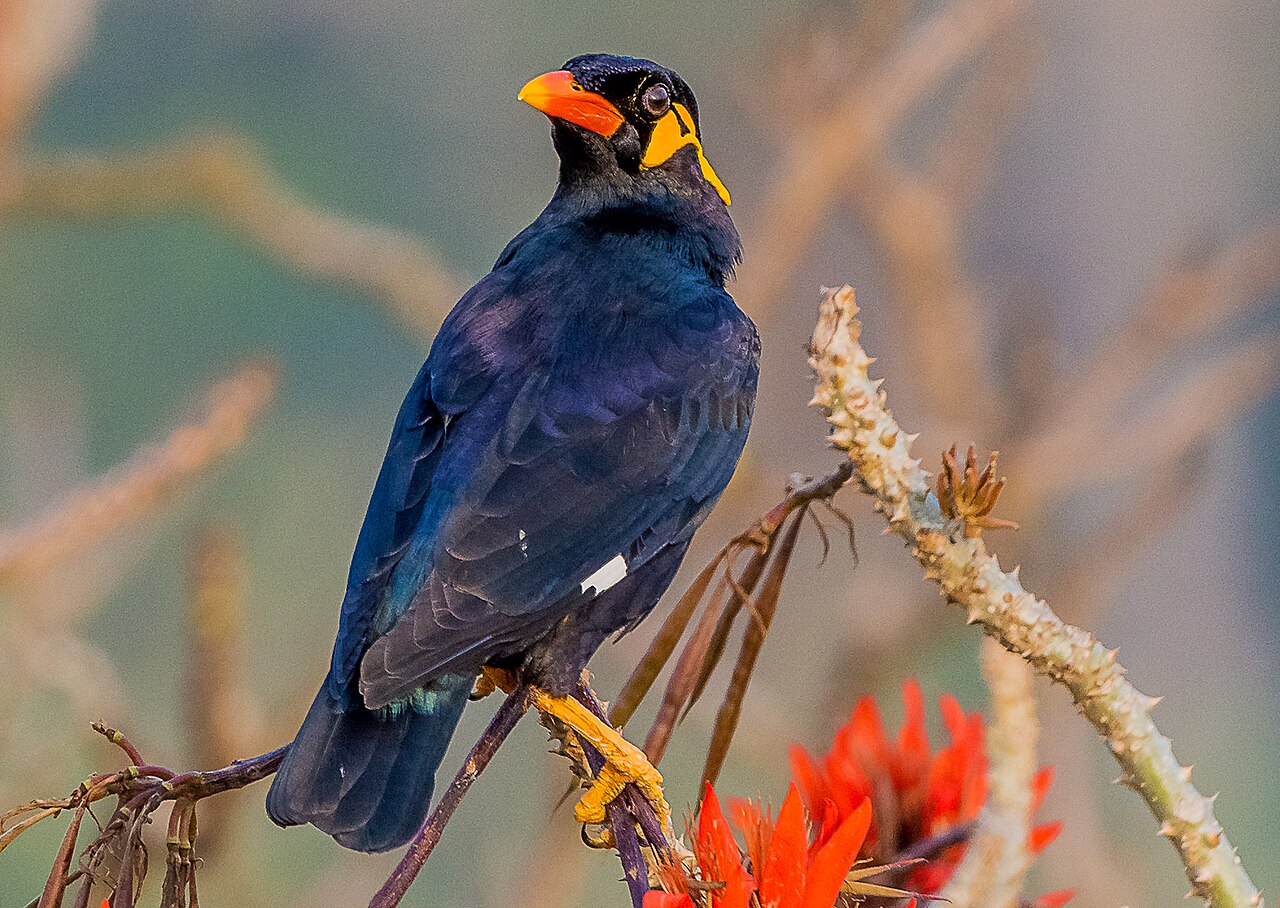
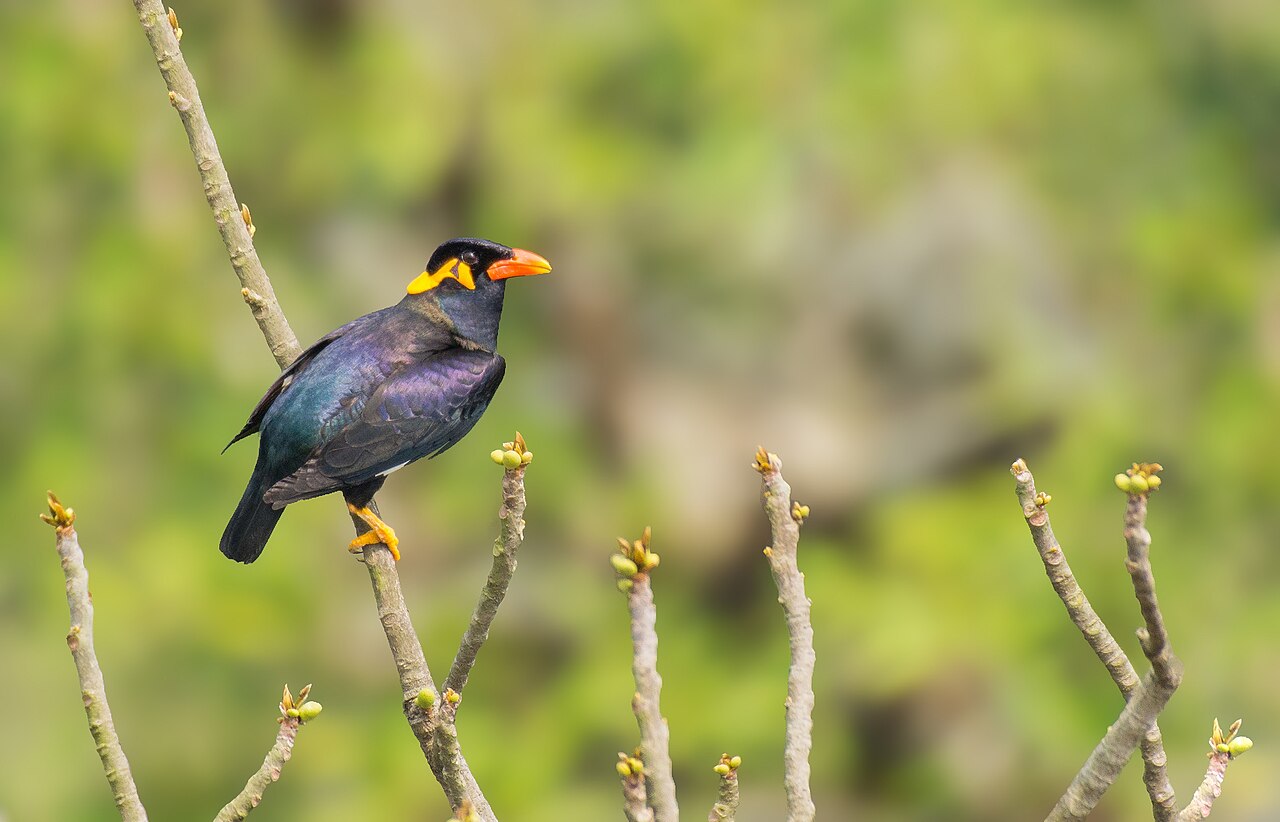
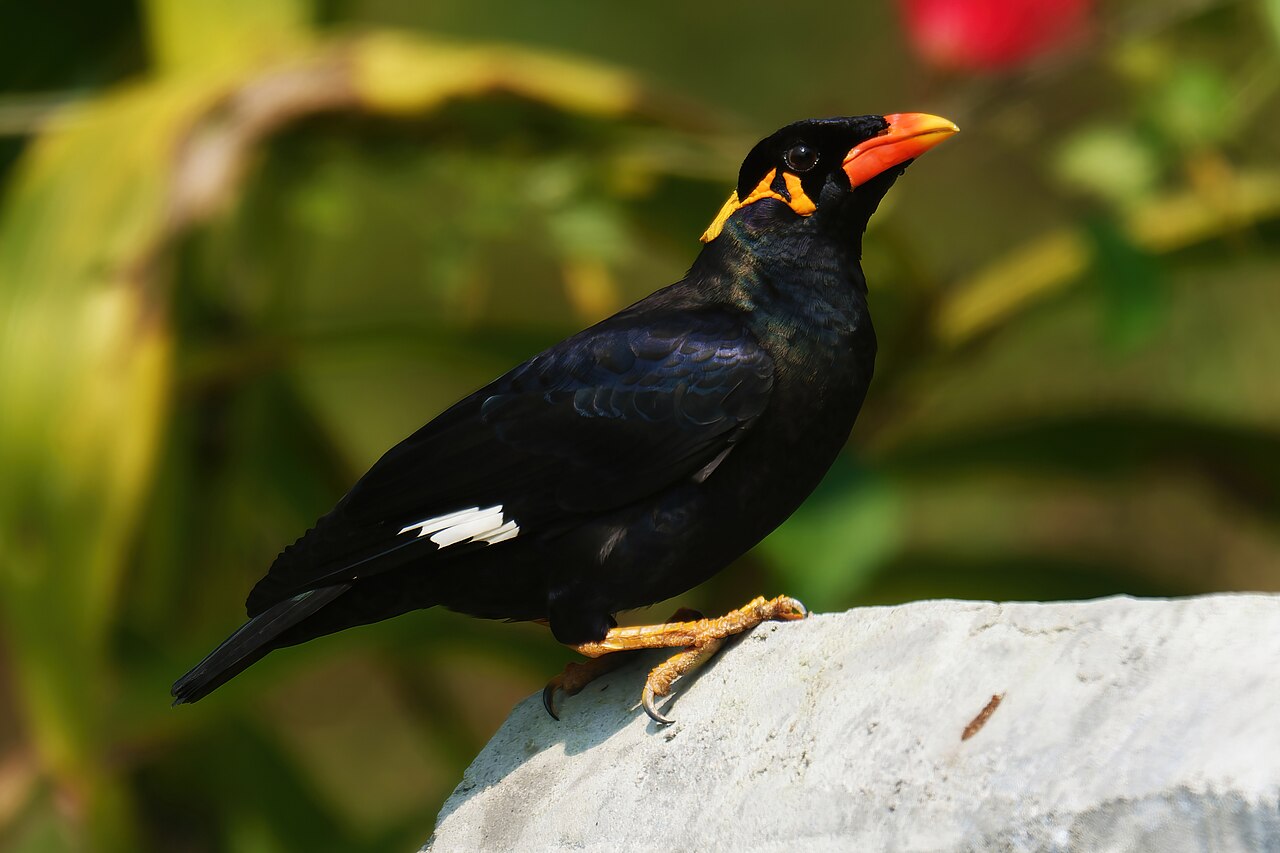
The common hill myna is a stocky jet-black myna with bright orange-yellow patches of naked skin and fleshy wattles on the side of its head and nape. It is overall green-glossed black plumage, purple-tinged on the head and neck, with large white wing patches obvious in flight. The bill and strong legs are bright yellow. Both sexes can produce an extraordinarily wide range of loud calls – whistles, wails, screeches, and gurgles – and in captivity they are among the most renowned mimics, on par with the grey parrot. The species is almost entirely arboreal, moving in large, noisy groups in tree-tops at the edge of the forest. It is fairly omnivorous, eating fruit, nectar and insects. The subspecies G. r.
Did You Know?
- The common hill myna is known to mimic other bird calls and sounds in the wild as part of its natural vocal repertoire.
- In captivity, it is one of the most renowned mimics, the only bird perhaps on par with the grey parrot.
- The subspecies G. r. miotera from Simeulue is critically endangered or possibly extinct, but has not been definitively documented as extinct in the wild in the late 2010s.
- The species is virtually extinct in Bangladesh due to habitat destruction and overexploitation for the pet trade.
Physical Appearance & Lifespan
The southern hill myna (Gracula indica) belongs to the starling family and presents a striking visual profile. Its plumage is a deep, glossy black that catches the light, while the legs stand out in a vivid yellow. The beak is particularly eye-catching, transitioning from a bright orange at the base to a yellow tip. White spots dot the primary flight feathers, adding contrast to the otherwise dark body. Like its hill myna relatives, it sports distinctive yellow wattles on the head. The bird is relatively compact, measuring roughly twenty centimeters in length. Both males and females share the same appearance, making them visually indistinguishable from one another. In terms of lifespan, individuals can survive anywhere from fifteen to thirty years, a considerable span for a bird of its modest size.
Habitat & Social Life
The southern hill myna calls the forested landscapes of southwestern India and Sri Lanka home, favoring tropical and subtropical dry broadleaf forests, mountainous terrain, mangrove thickets, and even plantation areas. Within these habitats, it typically perches high in the canopy, favoring the treetops at the forest's edge. Rather than flying long distances, it moves by hopping sideways along branches. Socially, this species travels in large, noisy groups of roughly half a dozen individuals. Flock members maintain constant contact through a wide variety of vocalizations, keeping the group cohesive as they forage. Their diet reflects the omnivorous nature typical of starlings, encompassing fruit, nectar, and insects. This flexible feeding strategy allows them to thrive across the diverse forest types they inhabit.
Vocal Talent & Etymology
Perhaps the most celebrated trait of the hill myna is its extraordinary vocal range. The bird produces a melodious voice capable of emitting a wide array of croaks and calls, and it is widely regarded as one of the finest talking birds in the avian world. It can imitate human sounds and speech with a degree of accuracy that reportedly surpasses that of parrots, making it a prized subject for captive breeding specifically for this vocal talent. The French name mainate for the bird traces back to the Indo-Portuguese mainato, originally the name of a songbird living near water, and is thought to be a metaphor referencing a man whose occupation was washing other people's clothes. Interestingly, the southern hill myna is considered slightly less vocally gifted than the common hill myna, a very similar species whose geographic range does not overlap with its southern counterpart.
Reproduction & Conservation Outlook
The southern hill myna follows a relatively straightforward reproductive strategy. Both sexes work together to construct a nest, typically selecting a hole in a tree as the breeding site. A clutch usually consists of two or three eggs, and because males and females are visually indistinguishable, both likely share in the parental duties. Despite these reproductive patterns, the species is experiencing a declining population trend. Nevertheless, the IUCN currently classifies it as Least Concern, indicating that while numbers are dropping, the species has not yet reached a level of threat warranting a higher conservation category. Its presence across multiple habitat types in southwestern India and Sri Lanka, combined with its adaptability to plantation areas, may offer some buffer against the pressures driving its gradual population decline.
Gallery
Frequently Asked Questions
What is the Common hill myna?
The Common hill myna (Gracula religiosa) is a starling species native to the hilly regions of South and Southeast Asia, measuring roughly 29 cm in length. It is one of the most frequently encountered birds in Asian aviculture.
Why is the Common hill myna's scientific name 'religiosa'?
The species epithet likely references the long-standing tradition of training these birds to recite sacred prayers. That vocal talent has cemented its place as a staple of aviculture across the region.
Where does the Common hill myna live?
This starling inhabits the hills of South and Southeast Asia, with its type locality on the Indonesian island of Java. Nine recognized subspecies exist across that broad range.
Why is the Common hill myna so popular as a talking bird?
It possesses a particularly strong vocal mimicry ability compared to many other starlings, making it a go-to choice for bird-keepers who want a chattering companion. Its very name hints at the centuries-old practice of teaching it to repeat prayers.
What is the conservation status of the Common hill myna?
The IUCN classifies the species as Least Concern, reflecting its wide distribution across South and Southeast Asian hills. Despite its popularity in the pet trade, it remains widespread and abundant in the wild.
More in Parrots And Songbirds 1-17
Spotted an error? Know more?
This is a living reference — every entry is fact-audited, and reader corrections feed straight into our audit queue. Suggest an edit · See this site's audit record